Steel, ink, mylar and a hand press — what actually happens between your artwork and your button.
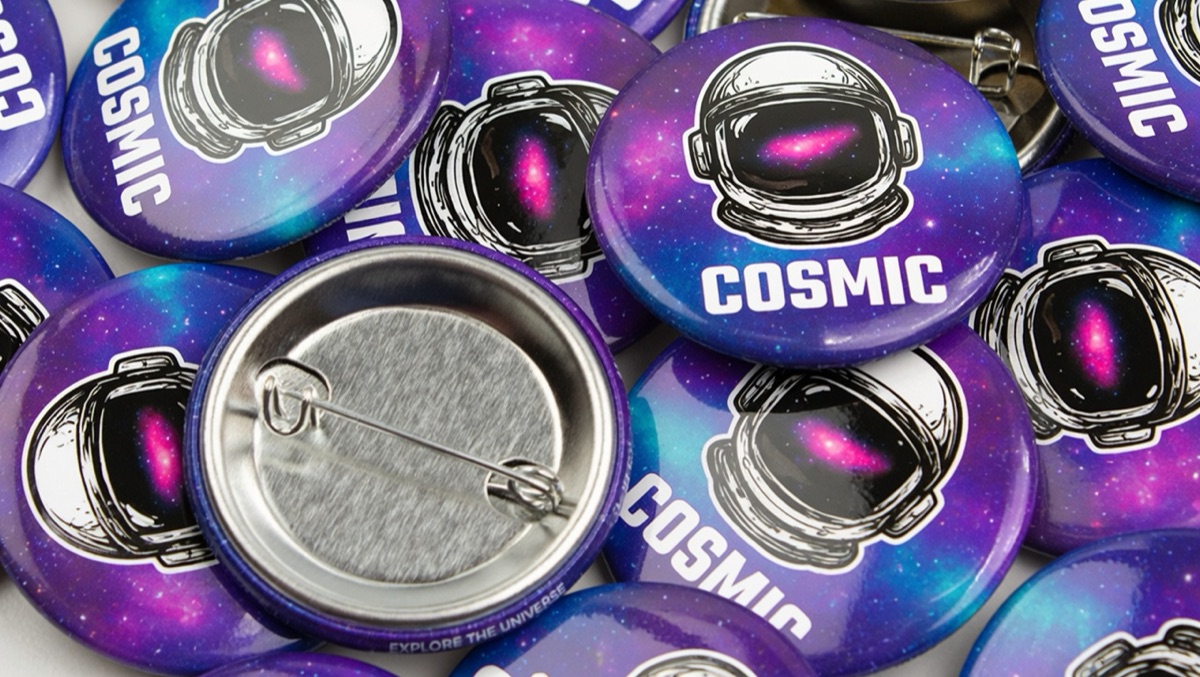
Every button we make has four parts: a steel shell that gives it structure, your full-colour print on coated paper, a crystal-clear mylar cover that protects the print and creates the glossy dome, and a steel pin-back (or magnet) that snaps it all together. No glue, no lamination — just mechanical crimping under about a ton of pressure.
A human looks at every file before anything prints: bleed, safe zone, resolution, colour. Problems get flagged before they become buttons.
Designs print in vibrant full colour on our digital press — gradients, photos and fine text all reproduce faithfully. Sheets are cut into circles slightly larger than the button face so the artwork can wrap the shell’s edge.
Shell, print and mylar meet in the die of a hand-operated button press. One pull crimps the layers over the shell; a second pull seats the pin-back and locks the whole assembly. An experienced operator presses hundreds an hour, checking as they go.
Buttons are inspected, counted and boxed — then it’s a pickup email or a courier label, depending on how you ordered.
The mylar dome is why decades-old band buttons still look sharp at record shows: the print never touches air, fingers or rain. Same parts, same physics, pressed at Dufferin & Lawrence.
Order online in any quantity — or email your artwork for a free proof, then pick up at Dufferin & Lawrence.
